

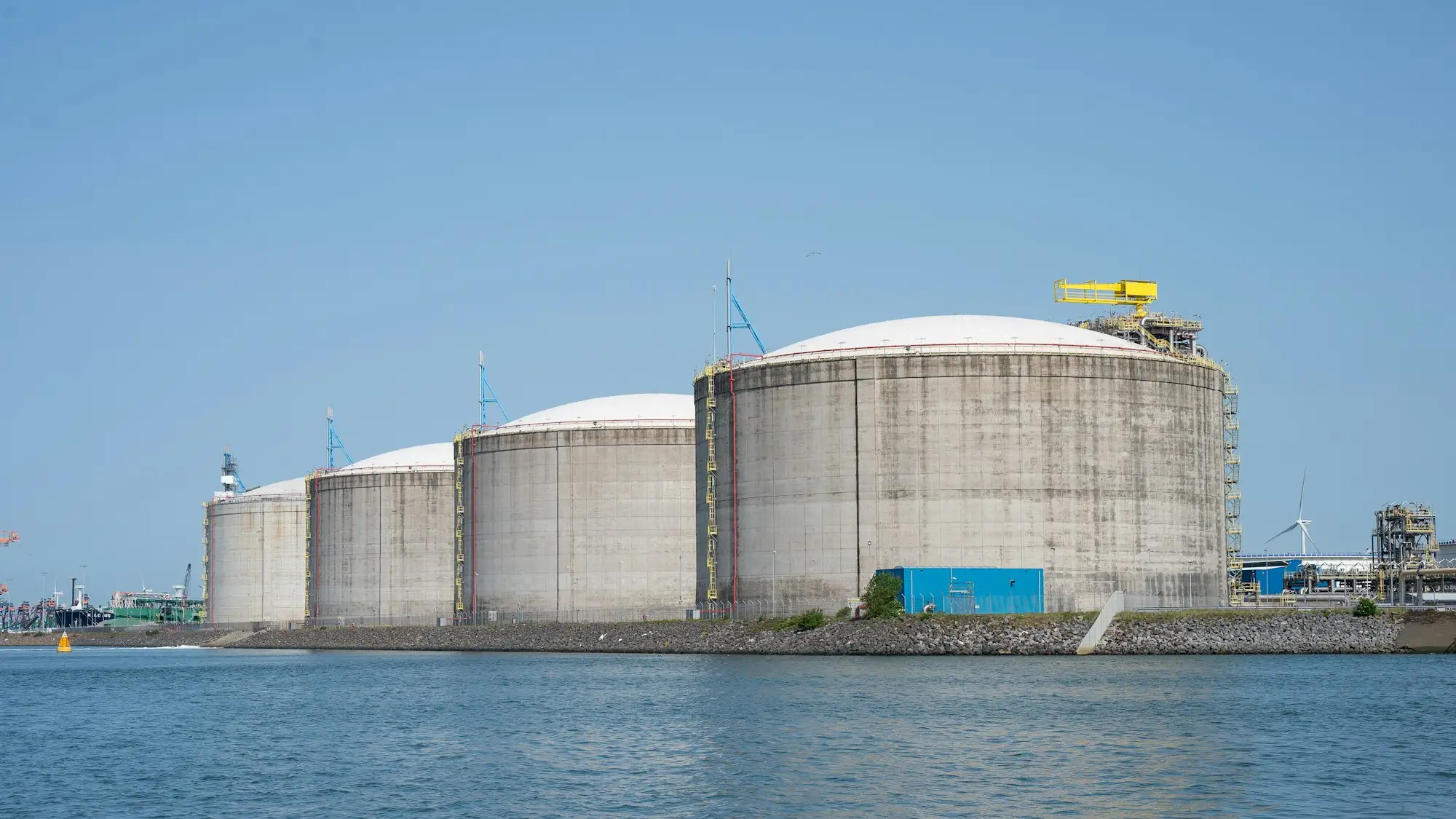
Energy
LNG sourcing and trading
ROXAY Trading sources and trades liquefied natural gas (LNG) for importers, power utilities and industrial consumers in markets that receive gas by sea rather than by pipeline.
At a glance
- Category
- Energy
- Typical buyers
- Importers, power utilities, industrial consumers, distributors
- Delivery form
- Seaborne, to regasification or receiving terminals
- Specification drivers
- Heating value, composition, Wobbe index, receiving terminal tolerance
- Contract structures
- Long-term SPA, master agreement with cargo confirmations, spot
- Price references
- JKM, TTF, Henry Hub, oil-indexed formulas
- Common Incoterms
- FOB, CIF, CFR — set per transaction
- Priority markets
- China, India, Pakistan, Africa, wider Asia
LNG Trading & Supply: Global Sourcing and Delivery Solutions
How Does International LNG Trading Work?
International liquefied natural gas (LNG) trade is the buying of LNG from a producer in one part of the world and the delivery of that LNG to a buyer in another part. This trade links gas that is in excess or non-functional in one place to markets that need energy. A transaction may be for a single shipment or for regular deliveries over many years. Gas trading is not only about moving gas physically but also about making the right decisions on buying and selling at the right time and under the right conditions.
The core principle of LNG trade is the ability to cool natural gas into a liquid form, load it onto special ships and carry it across the ocean. Upon arriving at its destination, the gas is regasified and dispatched to the local pipeline system or power plants. It is the trader’s job to make sure the trip is smooth, on time and at a reasonable price for both sides. In this process the trader has to handle the supply source, the ship, the port, insurance, payment and documentation all together.
LNG trade is different from other commodity trades in a number of ways. First, the product requires special ships and terminals for transport, creating a higher barrier to entry. Secondly, there is a high dependency on infrastructure; the capacity of a terminal or the state of a pipeline directly affects trade. Third, contracts are often long and complicated. These factors mean that trading LNG requires both physical and commercial expertise.
Another feature of the trade is the seasonality and the regional variances. The demand for heating during the winter months comes to the fore. The demand for cooling during the summer months takes precedence. This causes cargo to be shifted from one area to another. Merchants read these differences to send the cargo where it should be and build value.
The Roles of Producers, Portfolio Suppliers, Traders, and Buyers
There are several players in the LNG market, each with different roles. Sometimes these roles overlap, and sometimes the same company fulfils several roles.
Producers:
Owners of gas fields and liquefaction facilities. They convert raw natural gas into LNG and sell it mainly under long-term contracts. The main producers are companies from countries such as Qatar, the United States, Australia and Russia. The most important issue for producers is being able to enjoy the rewards of their large investments over many years. Hence, they prefer assurance mechanisms such as take-or-pay.
Portfolio suppliers:
Portfolio suppliers have a portfolio of supplies from various sources. They can mix volumes from their own plants, from other producers and from spot market purchases. This flexibility allows them to serve a large number of customers and respond to changes in demand. A portfolio reduces the risk of dependence on one source and allows servicing of different markets simultaneously.
Traders:
Traders sometimes buy and sell LNG cargoes without any production. They know how to seek opportunities, how to shift cargoes to where prices are highest and how to handle the risks in between. Traders are providing liquidity to the market, serving as a bridge between sellers and buyers. Simultaneously, they perform arbitrage, taking advantage of price differences.
Buyers:
Buyers are end users or their agents. They include national gas companies, industrial users, electricity and energy companies. Some buyers are traders who resell the cargoes. Big buyers often strike a balance between long-term and spot supply.
In practice, the roles often overlap. A producer can also trade, and a buyer can supply to other markets. This intermingling increases the market depth and provides the parties with a better understanding of each other.
Physical LNG Trading from Sourcing to Delivery
A physical LNG trade has a clear chain of events. If each link in this chain is not carefully managed, delays, additional costs or contract breaches may occur.
First, the trader gets supply from the manufacturer, a portfolio or the spot market. At this stage, the supply source is verified for reliability, quality and delivery schedule. Then there’s maritime transportation: trying to find a ship, trying to find its schedule and trying to match it to the loading terminal. Choice of ship depends on distance, amount of cargo, depth of port and cost.
The cargo is then loaded, transported and delivered to a receiving terminal. In this process the trader takes care of the documents, inspections and payments. The documents are bill of lading, quality certificate, certificate of origin and insurance. Complete documentation expedites the customs clearance and delivery processes.
Finally, the LNG is re-gasified and sent into the buyer’s grid. Post-delivery measurement and quality control are carried out. The transaction is closed if the parties agree. There are risks with each step. Weather, port delays and price fluctuations can all have an impact. Good traders are thinking ahead, not reacting as these issues arise. They have other ports, other ships and other sources of supply ready.
LNG Sourcing and Procurement Options
Buyers can obtain LNG in several ways; most use a combination. The right mix depends on the structure of demand, risk tolerance, access to the terminal and ship. The supply strategy also depends on the financial strength of the company, flexibility of contracts and market foresight.
Long-Term Supply, Short-Term Agreements, and Spot Cargoes
The long-term supply is over several years and provides stability for both the producer and buyer. It is usually specified in volumes and take-or-pay obligations. This is ideal for buyers who have stable and predictable demand. Long-term contracts also have more detailed arrangements on price formula, delivery point, quality and other issues.
Short-term contracts are for a few months or years. It provides greater flexibility and is often used to fill holes or test new suppliers. These agreements are appropriate for buyers who want to avoid long-term commitments but still want to be given some assurances.
Spot shipments are single shipments received within a short span. flexible but can be expensive and uncertain. It is useful if demand fluctuates or a quick supplement is needed. Spot market prices can fluctuate rapidly with supply and demand. This translates to both opportunity and risk for the buyer.
These three options are not alternatives to each other but rather complements. Smart buyers often mix the long-term core supply with spot flexibility. They therefore seek to obtain both security and price advantage.
Single-Origin Sourcing and Portfolio Supply
Single sourcing is buying from one manufacturer or facility. It’s simple and can build a strong relationship, but it concentrates the risk. If there is a problem at that facility, that impacts the supply. Single-source procurement generally offers predictability as regards quality and delivery, but flexibility is limited.
Multiple sources benefit portfolio sourcing. A portfolio supplier can combine volumes from multiple facilities and regions. This increases reliability and flexibility but can be more expensive and require more complex contracts. In the event of an interruption in one source, portfolio suppliers can fill the gap with another source. This gives the buyer great assurance.
Which model to choose depends on the needs of the buyer. If uninterrupted supply is critical, portfolio sourcing is the priority. Single-source supply can be attractive if cost and simplicity are priorities. Many buyers find a happy medium by utilising both.
Matching LNG Supply to Buyer Requirements
Not all LNG is the same, and not all buyers want the same thing. Supply to requirements adaptation is about volume, timing, quality and delivery point. If this alignment is not achieved, the buyer may end up with unnecessary costs or technical problems.
A power plant may need constant volumes with very minimal variation. An industrial user might need gas only at certain seasons. The trader might want the ability to resell. The supplier should be able to satisfy these requirements without disturbing others. Hence, the supply planning should be synchronised with the buyer’s production and consumption schedule.
Quality is important too. The composition of LNG produced from different gas fields is different. Some buyers will take a range; some will want a particular specification. Matching quality eliminates the hassle and the extra cost. High calorific value gas may not be suitable for some equipment, in which case blending or treatment is necessary.
The delivery point matters as well. Some buyers have their own terminals; some use terminals of other companies. Terminal capacity, port depth and pipeline connections could limit the availability of supply. Therefore, when choosing a supplier, one should evaluate not only the price but also the logistical compatibility.
Key Commercial Terms in LNG Transactions
Each LNG contract is made on the basis of a number of commercial terms. These include price, volume, delivery point, quality, payment and duration. It also deals with the risk distribution, i.e., who bears the transportation risk and who pays for delays.
Force majeure, termination and dispute resolution clauses are also important. It dictates what happens when things go wrong. When the terms are clear, it is less likely to lead to conflict, and it is easier to manage the deals. For example, a force majeure clause allows parties to suspend their obligations in the event of war or natural disasters.
Pricing is usually linked to an index; this index can be an oil, gas or other base index. Take-or-pay or flexibility provisions underpin volume commitments. Payment terms may include instruments such as guarantees or advance payments and letters of credit. The quality conditions determine the heating value, composition and impurity limits of LNG.
Each of these conditions is a negotiable point and suits the risk appetite of the parties. The rights and the obligations of the parties are well defined in a good contract.
Coordinating LNG Shipping and Delivery
Maritime transportation is the link between seller and buyer. Coordination means aligning ship schedules with loading and receiving terminals. It also includes things like weather conditions, port congestion and route changes.
A delay at one end can impact the other. Good coordination keeps everyone in the loop and enables fast course correction. It helps control costs, as ships waiting idle and missing slots are costly. The cost includes the waiting time of the ship, the port fees and the fuel consumption.
Coordination also involves the flow of documents. Documents for loading/unloading, quality certificates and payment instructions are to be prepared timely. Otherwise the ship will be sitting in port and incurring extra costs. So an experienced operations team is the unsung hero of trade.
Coordination also includes route choice. Passages through canals, straits and the open sea are different in cost, time and danger. Some are shorter and riskier; some are longer and safer. This balance must be well established in the trader.
Regional LNG Sourcing and Supply
Different regions have their own strengths. The Middle East offers significant and reliable volumes. The U.S. provides a flexible and competitively priced supply. Australia is close to the Asian market. Africa and Southeast Asia add more diversity.
Buyers tend to buy from multiple regions so as to spread their risk. Choose your region to view shipping costs and delivery times and contract terms. It also influences exposure to local politics and weather. For instance, if there is a political tension in one region, the supply can be disrupted; other regions take over.
Diversification by region is not just a risk management tool; it also offers pricing benefits. The price differences in different regions enable the buyer to purchase under better conditions. But this diversification is more complicated in terms of logistics and managing contracts.
How to Evaluate an LNG Trading and Supply Partner
Picking the right partner is as important as picking the right price. A good partner has good sourcing, good logistics and a good track record. They handle issues professionally and are good communicators.
Buyers should look at financial strength, contract flexibility and experience in their regions. References and past performance help. Equally important is a clear understanding of how the partner handles risk. For example, how many different sources does the supplier have, how many ships do they have access to and how fast can they react if there is a disruption?
The quality of the communication should also be assessed. A partner who flags problems early, is transparent and has solutions to hand is much more valuable in the long term. It’s not just the price; trust and consistency are just as important.
What Is LNG? A Complete Guide to Liquefied Natural Gas
What Does LNG Stand For, and What Does It Contain?
LNG is liquefied natural gas. Simply put, it is natural gas that has been cooled down to the point that it becomes liquid. The primary component is methane, the same gas that powers homes and power plants. It may also contain small quantities of ethane, propane, butane and other gases. Its composition varies according to source.
When cooled, the gas turns into a clear, colourless liquid at about minus 162 degrees Centigrade. This dramatically reduces its volume, making it far easier to store and transport. Vaporised, one volume of LNG would produce about 600 volumes of gas. This feature makes LNG economic for areas without pipelines.
LNG content dictates how much energy is produced and the emissions when it is burnt. High methane content results in cleaner burning. But if the impurities are not removed, then problems of freezing or corrosion may occur during transportation. This is why the production process is under strict quality control.
How Is LNG Produced?
The gas field starts LNG production. Raw gas is extracted and then cleaned to remove water, carbon dioxide, sulphur and other impurities. These must be removed, as they can freeze at low temperature or corrode the equipment. This purification step is critical to the safety and life of the facility.
After purification the gas is passed through a liquefaction plant. It is here slowly cooled until it is liquid. Liquefaction is one of the biggest costs in the LNG chain, as it takes a lot of energy to liquefy gas. The completed LNG is then stored in insulated tanks until a ship comes.
Liquefaction plants tend to be large-scale and take years to invest in. Thus, producers want to lock in their investments with long-term sales contracts. The efficiency of the facility directly influences the production cost and the sales price.
How Is LNG Converted Back into Natural Gas?
The LNG is transported to storage tanks at a regasification terminal for release at the receiving end. When gas is required, LNG is pumped through heaters or heat exchangers. This heats it up and turns it back into gas. This can be accomplished with seawater or another heat source.
The gas is then measured, conditioned and put into the pipelines. From there it goes to power plants, factories and houses. Regasification is a simpler and cheaper process than liquefaction but still calls for careful use and safety systems.
The terminal should be able to adjust the rate of gas delivery to match the demand. In winter the priority is demand for heating, while in summer the priority is electricity generation. Storage capacity and flexible operation are important to manage these fluctuations.
What Is LNG Used For?
LNG has a wide range of uses. Mainly it is used to produce electricity, making it possible for gas-fired power plants to start up and shut down quickly. It is also used in industry for heating and drying and as a raw material for chemicals and fertilisers. LNG also benefits the glass, ceramics and food industries.
In some countries LNG is used for heating and cooking in homes. It also powers ships and heavy trucks as a cleaner substitute for diesel. LNG can provide fuel to whole communities in remote areas where there are no pipelines. Other users of LNG include mining and remote industrial facilities.
LNG is also a weapon for energy security. LNG from several sources will make a country less reliant on a single supplier. It also plays a large role in balancing geopolitical risks.
LNG vs Pipeline Natural Gas: What Is the Difference?
Pipeline gas is transported from the source to the receiver through fixed pipes. Land transportation is cheap but restricted to connected areas. LNG is liquefied and shipped, enabling it to cross oceans and get to markets that are not connected by pipeline.
Pipeline gas is usually contracted to a particular route on a long-term basis. LNG is more flexible but also more expensive because of liquefaction, transport and regasification. It’s a matter of distance, volume and whether a pipeline is feasible between the two.
Pipelines deliver gas continuously; LNG is shipped. So you have to plan for and store LNG. Conversely, LNG has the ability to overcome political and geographical barriers.
LNG vs LPG vs CNG: Key Differences
LNG is liquefied natural gas, principally methane, cooled to very low temperatures.
LPG is a liquefied petroleum gas, which is primarily made up of propane and butane. It is a by-product of oil refining and gas processing and is stored under pressure rather than at a very low temperature. It is used for heating, cooking, and in some vehicles.
CNG is the abbreviation for compressed natural gas. Compressed gas – still a gas, but compressed under high pressure to take up less space. It is used mainly for vehicles and small-scale supply, not for large ocean transport.
So the main differences are the product itself, the way it is stored and what it is used for. LNG and CNG are two different forms of the same gas. LPG, however, is a different chemical mixture.
What Are the Benefits and Limitations of LNG?
LNG is net beneficial. It burns cleaner than coal or oil, giving off less carbon dioxide and much less sulphur and particulates. It allows gas to flow to markets that pipelines cannot reach. It also improves energy security through supply diversification.
But LNG has its limitations. The supply chain is costly and complicated. It needs large terminals and special ships. Methane can leak out during its production and transport, which, if not contained, chips away at its climate benefits. And prices can be volatile, making planning difficult.
Moreover, building LNG infrastructure takes a long time and requires a lot of capital. This creates a barrier to small marketplaces entering. Nevertheless, many countries are attracted to LNG because of its flexibility and clean combustion.
LNG Safety and Environmental Considerations
LNG is non-toxic and non-flammable in the liquid state. Its main hazards are its extreme cold and its capacity to ignite when mixed with air in the right proportion in its gaseous state. These risks are alleviated through careful design, training and monitoring of the terminals and ships. Standard features are leak detection systems and emergency plans.
From an environmental standpoint, LNG emits less carbon than other fossil fuels, but it is still a fossil fuel. The sector is acting to cut emissions from liquefaction, transportation and regasification. One of the most important things we can do is plug methane leaks. Also, other alternatives like renewable energy and hydrogen can also influence the role of LNG in the long term.
LNG Supply Chain: Liquefaction, Shipping, Storage, and Regasification
How Does the LNG Supply Chain Work?
The LNG supply chain is a series of interconnected steps linking gas fields with end users. It produces, refines, liquefies, stores, transports, receives, regasifies and delivers gas. The phases are dependent on one another.
The chain is long, and so any problem at any point can propagate through the entire system. A hold-up at the loading port can delay the ship and delay deliveries and inconvenience recipients. So physical equipment is no good without coordination.
The output of the previous link in the chain is the input of the next. This means that the whole system is tightly interwoven
LNG Storage and Export Terminal Operations
Gas treatment removes impurities that would cause troubles otherwise. Water is drained off to prevent ice from forming. Sulphur compounds and carbon dioxide are removed to protect equipment and meet specifications. They can also be separated from the heavier hydrocarbons. This stage is important to the efficiency and safety of the plant.
Then the clean gas is cooled by liquefaction until it becomes a liquid. This is true for large and energy-intensive trains. The design of these trains determines efficiency, cost and reliability. A well-managed facility provides a consistent quality of LNG that is required by the buyer.
There are different kinds of liquefaction technologies. Some are more efficient, and some are more durable. The choice of the facility is made according to the gas composition, climate and market conditions. This also influences production costs and, consequently, competitiveness.
How Is LNG Transported by Sea?
LNG is carried by special ships called LNG carriers. These ships are fitted with insulated tanks and systems to keep the cargo cold throughout the entire voyage. Some improve efficiency by operating the ship on natural evaporation gas. This provides fuel savings as well as emission reduction.
Size of ship, route and speed affect the delivery. Longer routes may require bigger ships or more careful planning. The shipping market itself can be tight or loose, impacting cost and availability. Efficiency is also determined by the age and technology of the fleet.
Ships also need to be compatible with the port so that narrows down the choices too. Not all ship sizes are accepted by all ports. Thus, the trader has to be very careful in matching the ship with the port.
LNG Receiving Terminals and Regasification
Receiving terminals unload, store and regasify LNG. They may be on land or floating. In large markets, land-based terminals are common, while floating units can be deployed more quickly and with a lower initial cost.
The regasification sends the gas to pipelines or directly to users. The terminal has to manage dispatch rates to meet demand, which can vary seasonally and even hourly. This is highly dependent on the storage and pipeline pressure.
The amount of LNG a country can import is determined by its terminal capacity. Even if prices are low, imports are limited if the capacity is not there. Therefore, many countries are making new terminal investments.
LNG Measurement and Quality Control
Measuring LNG is precise business, as a lot of money is depending on the right measurements. Calibration systems are used for measuring during loading and unloading. Check temperature, pressure and composition.
Quality control is to ensure that the LNG meets the specifications of the buyer. Gas of different composition is produced from different fields and may require blending or processing. Poor quality can cause problems for receivers and even damage equipment.
The measurement and quality control also help to build trust between the parties. Transparent and independent audits help to prevent disputes and ensure the smooth flow of trade.
Managing LNG Supply Chain Disruptions
Disruptions can be caused by a variety of factors: storms, strikes, equipment failure, geopolitical events, or a sudden spike in demand. Good planning minimises the effect. This may include backup capacity, supplier diversity, and alternative routes.
Contracts are the other instrument. Force majeure clauses, delay provisions and flexibility terms help parties deal with the unexpected. The best is a combination of preparation, communication and clarity in the contract. Also, insurance and risk transfer tools can be used as well.
Disruption management is not only about reacting but also anticipating. Weather forecasts, geopolitical analyses and market monitoring are used to anticipate disruptions.
LNG Contracts & Procurement: A Guide for International Buyers
How Do Buyers Procure LNG?
Buyers source LNG via a mix of long-term contracts, shorter-term arrangements and spot purchases. The right mix depends on the demand profile, risk appetite and access to infrastructure.
For a buyer with predictable and steady demand, long-term supply may be important for security. A buyer with variable demand may depend more on spot shipments. Many buyers will use both to achieve a balance between cost and reliability. The procurement strategy is also a function of the company’s financial strength and market foresight.
Another way for buyers to diversify risk is to increase the number of suppliers. A single supplier reliance can create serious problems in case of disruption. So diversification is the bedrock of a smart supply approach.
Main Types of LNG Supply Agreements
Long-Term LNG Sale and Purchase Agreements
Long-term contracts are normally for ten to twenty years or more. Producers have a stable outlet; buyers a reliable supply. Volumes are generally prescribed, but some flexibility is common.
These contracts often include take-or-pay clauses, whereby the buyer pays for a minimum volume even if it does not take delivery. This protects the seller’s investment but calls for careful planning by the buyer. In addition, details and regulations are given on such matters as the price formula, delivery point and quality.
Long-term contracts offer price stability and security of supply. But there is limited flexibility. The buyer abides by the terms of the contract in case of market changes. Therefore, contract negotiations should be handled with care.
Short-Term Contracts and Spot Cargo Transactions
Short-term contracts are for a few months to a few years. It provides more flexibility than long-term agreements and is often used to fill in gaps or test new suppliers.
Spot transactions are one-time deliveries bought and sold in a short time. They can be very flexible, but they are also more costly and more uncertain. Spot markets are useful when demand is uncertain or when a buyer needs to replenish quickly.
Prices in the spot market vary rapidly with supply and demand. So it is an opportunity and a risk to the purchaser. Experienced buyers watch the spot market closely to buy at the right time.
Master Agreements and Individual Cargo Confirmations
A master agreement outlines the general terms between two parties. This framework allows the verification of individual shipments. It cuts down the time and negotiation involved in each transaction.
The main agreement contains provisions on quality, delivery, payment and risk allocation. Each approval then specifies the volume, timing, price and other details specific to that transaction. This structure allows for several transactions and reduces legal uncertainty.
The main agreement also contains provisions on such issues as dispute resolution and termination. That means the parties don’t have to renegotiate the same issues with each new shipment.
FOB vs Delivered LNG Contracts
In an FOB contract, the seller is responsible for shipping, and ownership is transferred at the loading port. The buyer assumes the control of the ship and the risk of transportation. It may be cheaper if the buyer has good shipping connections. Also, the buyer can opt to ship to the market of his choice.
In a delivered contract, the seller arranges the shipping and delivers it at the buyer’s terminal. The seller risks more but earns a fee for taking that risk. Buyers with no shipping experience generally prefer delivered terms.
Choice impacts cost, control and risk. None is always better. It is contingent upon the capabilities and position of the buyer in the market. Some buyers use both models together for flexibility.
Key Terms in an LNG Supply Contract
Key terms are ‘volume’, ‘quality’, ‘delivery point’, ‘price’, ‘payment’ and ‘duration’. Force majeure, termination and dispute resolution are also important. Measurement, inspection and transfer of ownership are also important.
Each provision alters the risk between the parties. A buyer should know what it includes, not just the price. Clear text prevents disputes in the future. For example, if the delivery point is not defined, the parties may disagree as to who is responsible.
The quality conditions determine the calorific value, composition and impurity limits of the LNG. These conditions need to be acceptable for the equipment of the buyer. Otherwise, the efficiency can be reduced or the equipment can be damaged.
LNG Pricing and Payment Provisions
The price is usually linked to an index like a gas hub or oil price plus a fixed amount or adjustment. Some contracts use a multi-part formula. Payment terms include currency, timing, and collateral.
Letter of credit, guarantee or advance payment may be needed. These protect the seller but lock up the buyer’s capital. Negotiating payment terms is frequently just as important as negotiating price. Payment security is a big issue, especially in high- volume transactions.
Price formulas may be subject to limitations, such as caps and floors. This keeps the price fluctuations from getting too wild. But such provisions complicate the contract.
Managing Contract Performance and Delivery Risk
Performance risk includes late delivery, non-conforming shipments or loading failures. Contracts detail solutions, like compensation or substitute cargo. Buyers have to track performance and act early if problems come up.
Diversification is a good thing. Having multiple suppliers and multiple routes protects a buyer from a single failure. Some flexibility in contracts also helps if the market changes.
Performance monitoring should include delivery date and quality and document flow. Early warning systems help to catch problems before they get out of hand.
LNG Pricing: Benchmarks, Contract Formulas, and Delivered Costs
How Are LNG Prices Determined?
LNG pricing is driven by supply, demand, shipping costs and contract terms. There is no world price, as there is for oil. Different regions and different contracts have different references instead.
Prices may be determined according to long-term formulas or by short-term market forces. Other factors such as weather, economic growth and new supply projects also influence the situation. Political events and infrastructure constraints act on it too.
Pricing also takes competition and energy policies into account. For example, a country seeking greater energy independence might promote domestic production or diversified imports.
Spot LNG Prices vs Long-Term Contract Prices
Spot prices fluctuate with supply and demand at any given time. It can rise during cold snaps or supply interruptions and drop when the market is flooded with supply. It is clear but not steady.
Long-term contract prices are more stable. It’s normally indexed or tied to oil with a formula adjustment. That stability helps both sides plan, but it can also mean missing out on low spot prices.
The difference between the two types of prices provides arbitrage opportunities. This allows traders to purchase at low spot prices and sell at a profit through long-term contracts.
Regional Supply, Demand, and Infrastructure Constraints
If there are many suppliers but few buyers in an area, prices may be low. If you have a lot of demand in an area with limited terminal capacity, prices can be high. Channel capacity and shipping distances also affect the cost of shipping.
Infrastructure matters. Even if prices are low, if a country has no regasification capacity, it is not easy for it to import LNG. If the export capacity is small, the supply cannot be increased quickly.
These constraints are one of the main reasons for price differences between regions. But with more investment in infrastructure, price differentials may shrink.
Key Benchmarks Used in LNG Pricing
JKM and Northeast Asian LNG Markets
JKM stands for Japan-Korea Marker. This is a reflection of the spot LNG prices in Northeast Asia, one of the largest import regions in the world. It is often used as a benchmark for Asian trade.
JKM is influenced by weather, nuclear plant availability and competition from other fuels. It’s a good signal for anyone selling into Asia.
JKM also has a finger to the demand pulse in Asia. Winter months’ heating demand and summer months’ cooling demand can push JKM higher.
TTF and European Gas Market Linkages
TTF is the Dutch gas hub and the key reference for European gas prices. It is commonly used in many European LNG contracts and impacts global flows. High TTF typically means LNG shipments are heading for Europe.
TTF is driven by storage, pipeline imports and policy. It links Europe to the world LNG market.
TTF also reflects Europe’s energy security policies. TTF could be affected by supply diversification and renewables investments in the long term.
Henry Hub and US LNG Pricing Structures
Henry Hub is the primary U.S. gas benchmark. US LNG export projects generally buy gas from Henry Hub and sell LNG based on this or a formula linked to international prices. That structure has made U.S. LNG very competitive.
US volumes are fungible, helping to balance the global market. U.S. shipments can move fast when prices go up elsewhere.
Henry Hub prices are driven by the production of shale gas and pipeline capacity in the U.S. This also drives the cost structure of US LNG.
Oil-Indexed LNG Pricing and Brent Linkages
Many long-term contracts link LNG prices to oil, usually Brent. Gas prices are linked to moves in the oil market. This is common in Asia and in older contracts.
Oil-indexed pricing provides stability but could be slow to market changes. It also links LNG to a different supply-demand balance than gas.
This kind of pricing is common, in particular for financing long-term investments. The relationship between the oil and gas markets can change over time, however.
How Do LNG Contract Price Formulas Work?
A typical formula has an index, a multiplier, and a constant. For example, it could be a percentage of Brent plus a fixed number. Some formulas involve multiple indicators or seasonal adjustments.
Formulas can contain ceiling, floor and review items. They protect from too many movements, but they add complexity. Buyers and sellers negotiate the formulas carefully because they determine the cost for many years.
Formulas tend to be something of a compromise: enough certainty to protect the seller, enough wiggle room to attract the buyer. This balance is determined by market conditions and the bargaining power of the parties.
What Makes Up the Delivered Cost of LNG?
The delivered cost includes the commodity price, liquefaction fee, shipping, insurance, regasification and terminal fees. The fuel consumed on the ship and the losses incurred on the way are also added.
Each part varies by route and contract. A short journey is less than a long journey. A busy port can cause delays and costs. Knowing what goes into each of them helps buyers compare apples to apples.
It may also include financing costs and foreign exchange risk. Hence, the total cost is not only the apparent price.
Why Do LNG Prices Differ Between Regions?
Prices vary from region to region because the markets are not fully interconnected. Barriers include shipping costs, terminal capacity, and regulations. Demand patterns are different, too; some regions need more gas in winter, others in summer.
Political factors can exacerbate the gap. Sanctions, tariffs, and trade policy can redirect flows and change prices. Arbitrage differences tend to narrow over time, but this is not always quick.
Price differences across regions create opportunities for traders. At the same time, it gives buyers an incentive to diversify.
How Do Buyers Manage LNG Price Exposure?
Buyers hedge, contract and diversify their exposure. Some use financial instruments to fix prices. Others combine long-term and spot purchases to achieve a balance of stability and flexibility.
Operational decisions are important too. Market moves enable buyers to move volumes, alter delivery schedules or resell shipments. Good planning and market awareness are necessary.
Contract negotiations also include price risk management. Ceiling and floor provisions can protect the buyer from large swings.
LNG Trading in the Middle East: Production, Sourcing, and Export Logistics
The Middle East’s Role in Global LNG Supply
The Middle East is among the most important LNG regions in the world. It has vast reserves of gas and has exported LNG for decades. Its location between Europe and Asia gives access to both major markets.
The region is characterised by a stable and huge supply. Its producers have extensive experience and a good infrastructure. Hence, they are an indispensable partner for buyers seeking security.
Low production costs are also a feature of the Middle East. This makes the region competitive in the world market.
Qatar’s LNG Export Industry
Qatar is among the world’s largest LNG exporters. It is produced from large liquefaction trains and huge gas fields. It has ploughed huge amounts of money to add capacity.
Qatar sells spot and long-term cargoes. Its scale and consistency of supply are widely recognised. Qatari volumes are at the core of many buyers’ portfolios.
Qatar also has the ability to redirect its gas to other markets. This also makes it an attractive supplier to Asia and Europe.
LNG Supply from Oman and the UAE
Oman and the UAE also export LNG, but in smaller volumes than Qatar. Oman has export facilities and is supplying Asian and European buyers. The UAE produces LNG and sometimes imports LNG to meet its domestic demand.
These countries bring diversity to the Middle East supply. That is good for buyers who want regional choices beyond just one producer.
Both countries are working on capacity expansion and new projects. This means that the regional supply will increase in the long run.
How Is LNG Sourced from Middle Eastern Suppliers?
In the Middle East, procurement usually begins with direct negotiations with manufacturers or their representatives. Buyers can also purchase spot cargo or enter into long-term contracts. Some are already working through traders who own the supply.
Due diligence is essential. Buyers should check out seller performance, contract terms and delivery capability. Also consider local and ship regulations.
Usually the procurement process is long and complicated. Hence, it requires patience and careful planning.
Commercial Considerations for Middle Eastern LNG
Some contracts are indexed on oil, others on gas indices. Payment terms, currency and credit support can be negotiated.
Political and logistical factors can influence agreements. Sanctions, regional tensions and shipping routes can affect conditions. Buyers need to be aware of these risks before committing.
Often sourcing from the Middle East is on a long-term relationship basis. Price is not the only factor; trust and stability are equally important.
LNG Export Logistics from the Middle East
The region’s export terminals can process big volumes. It loads ships quickly and operates year-round. Asia is connected through the Strait of Hormuz. Europe is connected through the Suez Canal or around Africa.
The route choice will determine the cost and time it takes. Narrow passages increase the risk, so some buyers go the alternative route if they can. Insurance and security regulations are part of planning.
Logistics efficiency increases the competitiveness of the region. A well-organised terminal reduces waiting time of the ship and costs.
Managing Regional LNG Supply Risks
Risks include weather, equipment failures and geopolitical tensions. Diversification helps. If you’re sourcing from multiple regions, you’re less reliant on any one disruption.
Contracts can be useful too. Force majeure, diversion rights and flexibility clauses provide buyers with options when things go wrong. Also, keeping the lines of communication open with suppliers is equally important.
Risk management is not limited to contracts but also to operational readiness. Plan ahead with other sources and routes.
LNG Supply in Asia: Demand, Import Markets, and Procurement
What Drives LNG Demand in Asia?
Asia is the world’s biggest LNG import region. Demand is spurred by economic growth, rising energy needs and a move away from coal. Many Asian countries have no domestic gas and rely on imports.
The weather conditions are also important. Cold winters and hot summers drive up the need for heating and cooling. The trend is also reinforced by industrial growth and the new gas-fired power plants.
Many Asian countries, in addition, want to diversify their sources of supply in an effort to increase energy security. This also provides structural support to LNG demand.
China’s LNG Market
China is an important LNG importer and an emerging power in LNG. It provides gas for electricity, industry and home heating. LNG is complemented by domestic production and pipeline imports, but demand often outstrips them.
China buys long-term and spot cargoes. Buying patterns, especially in winter, can affect global prices. The future demand is also influenced by coal and renewable energy policies.
China is also fast developing its own LNG infrastructure. Import capacity is growing with new terminals and storage facilities.
India’s LNG Market
India uses LNG to supply power plants, industry and city gas networks. Price sensitivity is high, and buyers switch from LNG to other fuels depending on cost.
India has several regasification terminals and is developing more. It also seeks to lock in supply with long-term contracts. Growth in infrastructure will determine the amount of LNG it can absorb.
India is also trying to boost domestic gas production. But that might not do away with imports entirely.
Japan and South Korea’s LNG Markets
Japan and South Korea are mature importers with much of the infrastructure in place. They depend on LNG for power and industry. Both countries have diversified supply portfolios and large storage capacity.
Nuclear availability impacts LNG demand. Gas use falls when reactors are running and LNG imports rise when they are shut down. Both countries are studying hydrogen and green technology. Both are also experienced buyers of LNG. They’re good at negotiating contracts and managing risk.
LNG Supply to Pakistan and Bangladesh
Pakistan and Bangladesh are new importers. They are using liquefied natural gas (LNG) to ease gas shortages and to help power generation. In some cases, both use floating storage and regasification units.
Funding and infrastructure are challenges. Such are also price volatility and payment capacity. But as the economy grows, demand is expected to increase.
LNG Demand in Southeast Asia
Southeast Asia is an emerging LNG region. Indonesia, Malaysia, Thailand and Vietnam are developing import capacity. It’s complicated because some are exporters too.
Electricity needs and cheaper domestic gas are driving demand. How fast the region becomes a major importer will depend on infrastructure and policy.
It is also a region attracting attention from new LNG projects and terminal investments. This means that demand will go up in the long term.
How Is LNG Delivered to Asian Buyers?
LNG ships from the Middle East, Australia, the US and elsewhere to Asia. Routes differ in distance and price. The risk is increased by narrow channels such as the Strait of Malacca.
LNG is delivered to buyers on land or at floating terminals. From there it goes into gas pipelines or is used directly. The reliability of delivery is affected by shipping, port capacity, and the weather.
Timing is critical on deliveries to Asia. Shipping schedules can be tightened during winter demand and lead to delays.
LNG Procurement Strategies for Asian Markets
Asian buyers employ a combination of long-term contracts and spot buying. A lot of people invest in production projects or transportation to ensure supply. Inter-regional diversification lowers risk.
Flexibility is essential. Buyers who can modify volumes, routes or schedules are better able to respond to changes in the market. Bargaining power can also be increased by collaboration among buyers.
Some Asian countries are also developing joint procurement mechanisms. This can help them to get better prices and terms.
What a buyer needs to define
An LNG enquiry needs four things before supply can be qualified:
- Receiving point — the discharge port or regasification terminal. This is the constraint that decides whether the trade is possible at all.
- Volume — per cargo, and whether the requirement repeats.
- Delivery window — LNG cannot be held indefinitely; timing is part of the specification.
- Incoterm — whether shipping sits with the buyer or the seller.
Specification detail such as heating value and composition matters as well, particularly where the receiving terminal or the end use has a narrow tolerance.
How ROXAY handles an LNG trade
We qualify available supply against the specification and window, confirm that the receiving point can take the cargo, structure the commercial terms and coordinate the contract and delivery sequence with both counterparties.
Where a requirement is recurring rather than one-off, we structure it so the terms are settled once and individual cargoes are confirmed against them, rather than renegotiating from the beginning each time.
We do not operate carriers or terminals, and we do not present ourselves as if we did. Shipping is arranged per transaction against the agreed Incoterm.
We do not publish origin countries, suppliers or routes.
Questions buyers ask
Does ROXAY Trading supply LNG on FOB or CIF terms?
Both are workable. FOB places the shipping arrangement with the buyer, CIF places it with the seller; which one applies depends on the route, the buyer's chartering capability and what both counterparties can support. The Incoterm is agreed per transaction.
What information is needed to quote an LNG requirement?
The discharge port or receiving terminal, the volume, the delivery window and the preferred Incoterm carry the most weight. Without a defined receiving point an LNG enquiry cannot be qualified, because not every market can physically take a seaborne cargo.
Which price references apply to an LNG cargo?
There is no single world price for LNG. Northeast Asian spot cargoes are commonly referenced to JKM, European volumes to TTF, US-sourced volumes to Henry Hub plus a liquefaction and shipping structure, and many long-term contracts remain indexed to oil. Which reference applies is part of the commercial structure rather than a fixed rule.
Does a buyer need a long-term contract to secure LNG?
No. Supply can be structured as a long-term sale and purchase agreement, as a master agreement under which individual cargoes are confirmed, or as a single spot cargo. Steady baseload demand usually justifies term cover; variable or seasonal demand is often better served by spot and short-term purchases.
Can ROXAY arrange a single LNG cargo rather than a term contract?
Yes. Single-cargo and recurring supply are both possible. Which structure works better depends on the buyer's consumption profile and how much certainty they need over the delivery window.
What determines the delivered cost of an LNG cargo?
The commodity price is only part of it. Liquefaction, shipping, insurance, boil-off during the voyage, regasification and terminal charges all sit in the delivered figure, and each varies with the route and the receiving facility. Comparing a FOB quotation with a delivered quotation without accounting for these is the most common costing error buyers make.
Does ROXAY own LNG carriers or terminals?
No. ROXAY Trading positions itself on its commercial network and sourcing capability rather than on owned assets. Shipping is organised per transaction according to the agreed delivery terms.
More in Energy
LPG
ROXAY Trading sources and trades liquefied petroleum gas (LPG) — propane, butane and blends set to the destination's climate and specification — for importers, distributors and industrial consumers.
Natural Gas
ROXAY Trading sources and trades natural gas for industrial consumers, power generators and importers — as pipeline supply or, where no connection exists, as LNG.