

A procurement manager emails us asking for “liquefied gas for our plant”. It sounds like a simple request. But one question changes everything that follows: do they mean LNG or LPG?
The names are only one letter apart, and both are gases turned into liquid so they can be moved. But they’re different products. They come from different molecules, travel on different ships, are priced against different benchmarks and need different equipment at the receiving end. Picking the wrong one isn’t a small mistake.
Here’s how they compare, in plain terms.
What are LNG and LPG?
LNG (liquefied natural gas) is natural gas, mostly methane, cooled to around −162°C until it becomes liquid. This shrinks its volume by roughly 600 times, which is what makes it possible to ship gas across oceans where there’s no pipeline.
LPG (liquefied petroleum gas) is propane, butane or a blend of the two. It comes partly from processing natural gas and partly from oil refining. Unlike LNG, it turns liquid under fairly moderate pressure at normal temperatures. That’s why you see it in steel cylinders and small tanks.
So the simplest way to remember it: LNG is natural gas made cold, and LPG is a different set of gases put under pressure.
How each one is liquefied and stored
LNG needs cryogenic infrastructure. It’s produced at large export plants or smaller liquefaction facilities and carried in insulated tanks. Large seaborne cargoes are received at import terminals or floating storage and regasification units (FSRUs). Smaller volumes can be delivered by road tanker or cryogenic container to sites with suitable storage and regasification equipment.
LPG is far more flexible. Large volumes are often shipped refrigerated, but on land LPG can sit in pressurised tanks, bullets and cylinders. Smaller buyers can receive it by truck or rail without a dedicated terminal.
The practical question is which supply route your site can support. LNG requires access to terminal regasification or a viable small-scale delivery route with on-site cryogenic storage and regasification. If neither is available, LPG or pipeline gas may be more practical. We compare LNG with pipeline supply in LNG vs pipeline natural gas.
Shipping: two very different fleets
LNG carriers are specialised vessels with heavily insulated containment systems. Modern ships typically hold around 170,000–180,000 cubic metres. Cargoes are large, and the trade relies on a limited number of export and import terminals.
LPG carriers come in three main types: fully pressurised, semi-refrigerated and fully refrigerated. On long routes, Very Large Gas Carriers (VLGCs) of around 80,000+ cubic metres move bulk cargoes. Smaller pressurised ships handle short-sea and coastal trade.
For buyers taking full ocean-going LNG cargoes, large volumes and careful scheduling are central to procurement. Smaller buyers may instead source LNG through regional distributors using smaller vessels, road tankers or cryogenic containers, where available. For both LNG and LPG, parcel size depends on the delivery route and receiving setup.
What they’re used for
There’s some overlap, but the main uses differ.
LNG mostly feeds power generation, gas grids and large industrial users who need a steady supply of natural gas. Smaller volumes are used as fuel for ships and heavy trucks.
LPG covers a broader mix. Households and businesses use it for heating and cooking. It’s also used as autogas, in industrial heating and drying, and, importantly, as a petrochemical feedstock. Propane dehydrogenation (PDH) plants turn propane into propylene, which is then made into polypropylene.
Put simply: LNG is mainly an energy product, while LPG is both an energy product and a chemical raw material.
How they’re priced
The two products follow different benchmarks.
LNG prices are often linked to regional gas indices such as JKM in Asia or TTF in Europe. Some long-term contracts are linked to oil instead, or to US Henry Hub gas plus liquefaction and shipping costs.
LPG in the Middle East and Asia is widely priced against the Saudi Aramco Contract Price (CP), set each month separately for propane and butane. Other important references include Mont Belvieu in the US and the Far East Index. A cargo is usually priced at the benchmark plus or minus a differential, plus freight.
Because of this, LNG and LPG prices don’t always move together. Each responds to its own supply, demand and season. You can read more in our guide to what drives commodity prices.
Safety and handling
Both are flammable and need trained handling, but they behave differently if released.
LPG vapour is heavier than air, so it can gather in low-lying areas such as drains and basements. LNG vapour is very cold and stays low at first. Once it warms, natural gas is lighter than air and disperses upwards.
These differences affect site design, ventilation and storage rules. Your safety and engineering teams should sign off on whichever product you choose.
LNG vs LPG at a glance
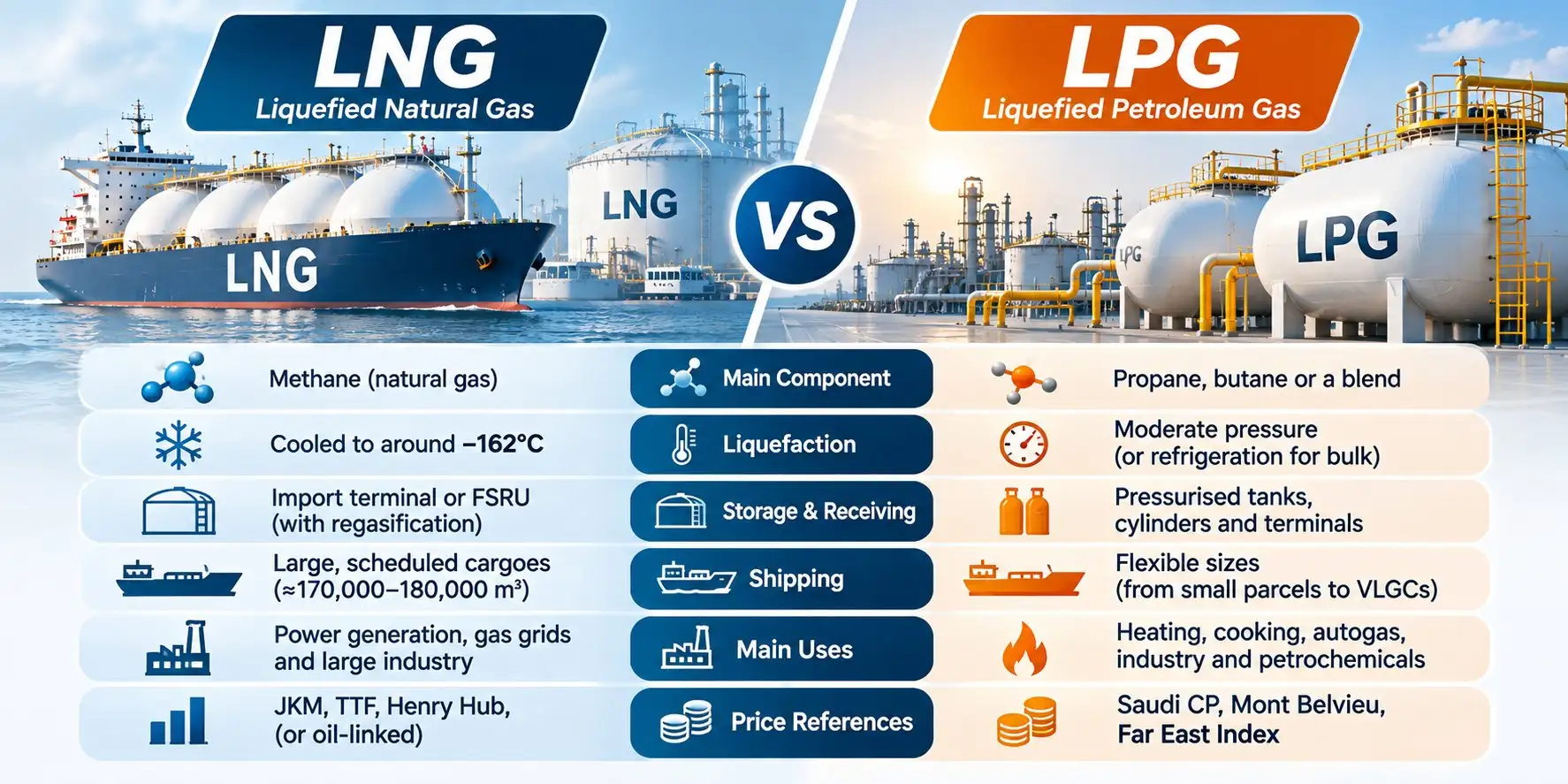
| LNG | LPG | |
|---|---|---|
| Main components | Methane | Propane, butane or blends |
| How it’s liquefied | Cooled to about −162°C | Moderate pressure, or refrigeration for bulk shipping |
| Receiving infrastructure | Import terminal or FSRU; on-site cryogenic storage and regasification for small-scale deliveries | Pressurised tanks, cylinders, terminals |
| Typical cargo sizes | Large seaborne cargoes; smaller vessel, road tanker or container deliveries where available | Flexible, from small parcels to VLGCs |
| Main uses | Power, gas grids, large industry | Heating, cooking, autogas, industry, petrochemicals |
| Common price references | JKM, TTF, Henry Hub, oil-linked | Saudi CP, Mont Belvieu, Far East Index |
| Vapour behaviour | Lighter than air once warmed | Heavier than air |
Which one makes sense for your operation?
Most of the time, your infrastructure decides for you.
LNG can suit buyers who need natural gas for power or an existing gas-fired process. Large, steady demand may support terminal-based supply, while smaller sites may use road tanker or container deliveries with on-site storage and regasification. Local availability, infrastructure and delivered cost determine whether either route is workable.
LPG tends to suit buyers whose equipment uses propane or butane and who need flexible delivery volumes, including smaller or seasonal requirements. It can also serve sites without natural gas supply and plants that use propane or butane as a petrochemical feedstock.
If you can’t decide, start with what your burners, boilers or process units are designed for. Switching fuels usually means changing equipment, not just your supplier.
What to define before you request a quote
Whichever product you need, a clear requirement speeds things up. Have these ready:
- Product and specification (LNG quality, or propane/butane ratio for LPG)
- Volume per shipment and over the contract period
- Delivery point and receiving infrastructure
- Preferred Incoterm (FOB, CFR or CIF, see our Incoterms guide)
- Delivery window and frequency
- Payment terms and instrument
- Inspection requirements at loading and discharge
Sourcing LNG or LPG with ROXAY
ROXAY Trading supplies LNG and LPG to industrial and commercial buyers, alongside our wider energy portfolio.
If you’re not sure which product fits your operation, send us your requirement: product, volume, delivery point and receiving setup. We’ll tell you honestly what’s workable.
Final terms always depend on confirmed availability, KYC checks and a signed contract. Submit a requirement to get started.