

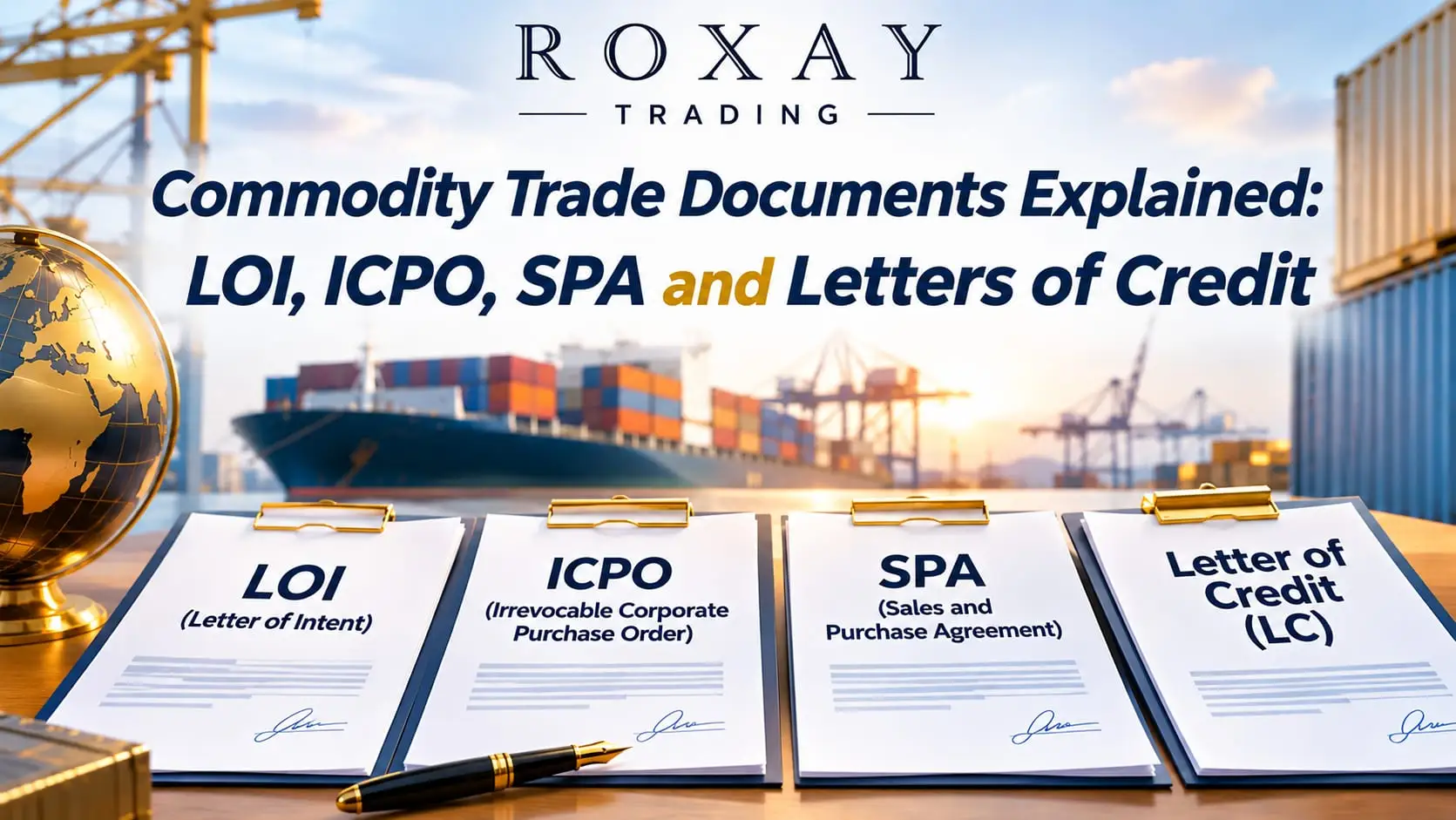
Ask anyone who has worked on a physical commodity deal what slowed it down, and the answer is rarely the price. It is usually the paperwork. A cargo of steel coil or a shipment of LPG moves across borders, between banks and through ports, and every one of those steps needs a document that someone else will check.
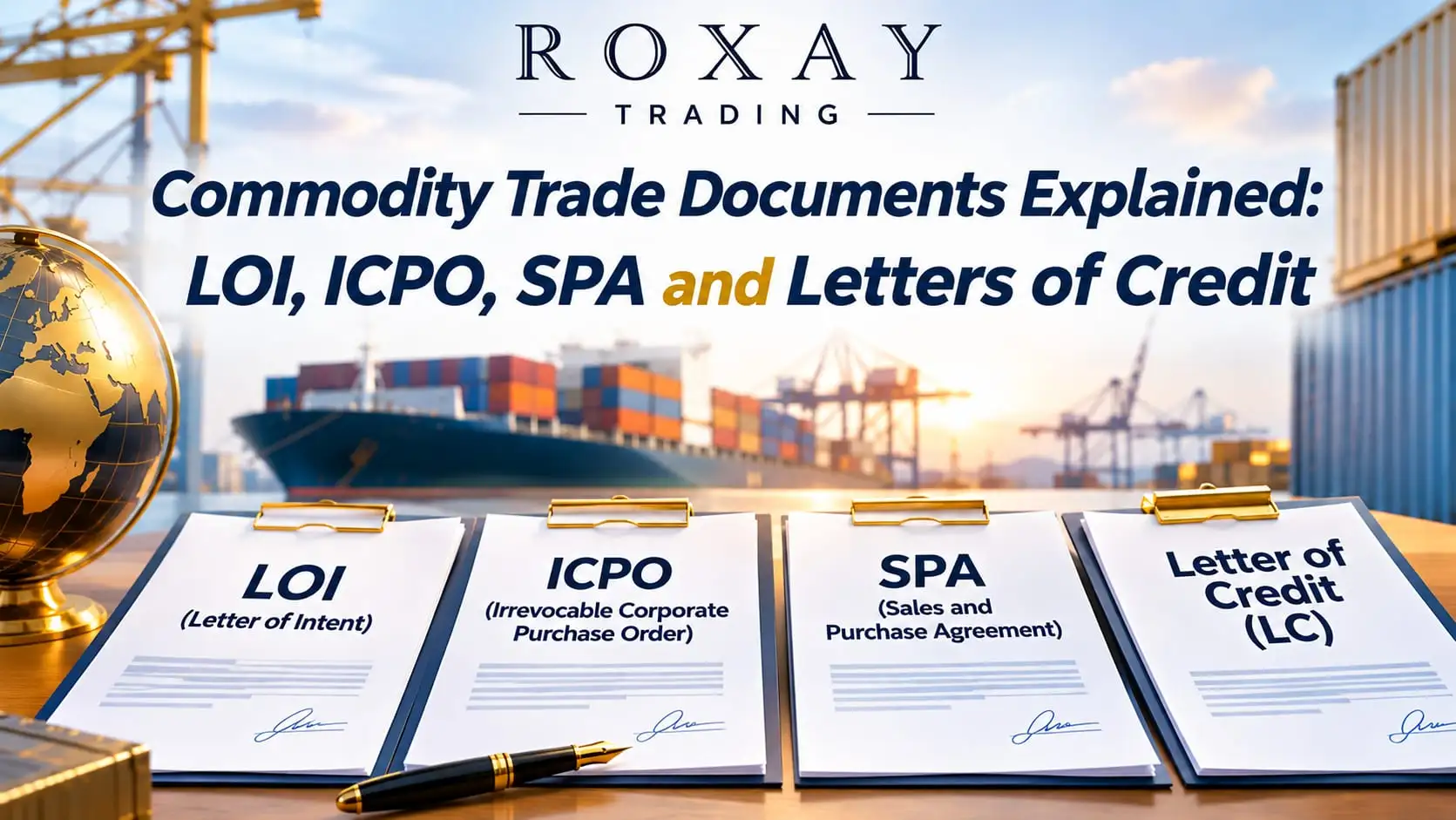
For buyers new to international sourcing, the list of acronyms can feel like a test. LOI, ICPO, FCO, SPA, L/C, B/L. This guide walks through what each one is, where it sits in the deal, and which ones actually carry weight.
It is written for industrial buyers, importers and procurement teams. It is general information, not legal or financial advice.

Why documents matter so much in physical trade
In physical commodity trading, the buyer and seller are often in different countries and may never meet. The goods are on a vessel for weeks. Money moves through banks that have no way to inspect the cargo themselves.
Documents fill that gap. They tell the bank what was agreed, prove that goods were shipped, confirm what was loaded and in what condition, and decide who owns the cargo at any given moment. When documents are wrong or missing, payment stops and the cargo can sit at port running up costs.
So the paperwork is not a formality. In many ways, it is the deal.
The early stage: LOI, ICPO, SCO and FCO
These are the documents most buyers see first. They are also the ones most often misunderstood.
- LOI (Letter of Intent). A buyer’s statement that they are interested in a product, usually with rough quantities, specifications and delivery terms. It signals intent. In most cases it does not bind anyone to buy.
- ICPO (Irrevocable Corporate Purchase Order). A buyer’s document setting out what they want to purchase. The word “irrevocable” does not by itself determine its legal effect. Whether it creates binding obligations depends on its wording, the applicable law and how the parties accept it or act on it. A contract may arise before a separate SPA is signed, so review the terms before issuing or accepting one.
- SCO (Soft Corporate Offer). A seller’s indicative offer. It outlines product, price range and terms, and invites the buyer to respond.
- FCO (Full Corporate Offer). A more detailed offer from the seller, with firmer pricing, quantities, delivery terms and payment conditions. If the buyer accepts, the parties usually move on to drafting the contract.
These documents are useful for opening a conversation. The problem is that in some corners of the market they have taken on a life of their own. Offers get forwarded through long chains of intermediaries, each adding a margin, and none of them actually holding the product. A real seller with real cargo will usually want to verify the buyer before issuing anything firm, and a real buyer should expect the same in return.
The contract: the SPA
The Sales and Purchase Agreement, or SPA, is where the deal becomes real. This is the document that both sides are bound by, and it is the one worth reading line by line.
A solid SPA normally covers:
- Product and specification. Exact grade, chemical or physical properties, tolerances and the standard it is measured against.
- Quantity. Total volume, any tolerance (for example plus or minus 5 percent), and whether delivery is a single shipment or spread over months.
- Price. Fixed price or a formula linked to an index, the currency, and how adjustments are handled.
- Delivery terms. The agreed Incoterm, such as FOB, CFR or CIF, plus the load port, discharge port and shipment window.
- Payment terms. The instrument used, the timing, and which documents must be presented to get paid.
- Inspection. Who inspects the cargo, where, and whose results are final.
- Disputes. Governing law, arbitration venue and what happens if either side fails to perform.
Most problems that appear later in a deal trace back to something vague in the SPA. If a specification says “standard quality” instead of a measurable figure, expect an argument at discharge.
Getting paid: letters of credit and other instruments
Payment is where buyers and sellers are most exposed, so the choice of instrument matters.
- Letter of credit (L/C). A common payment instrument in international commodity trade. The issuing bank undertakes to honour a complying presentation under the credit’s terms. Where the credit is subject to the ICC’s UCP 600 rules, banks deal in documents, not goods. Article 14(d) does not require data to be identical across documents, but it must not conflict when read in context with the credit and international standard banking practice. A discrepancy may lead to refusal, but a wording difference alone does not necessarily make a presentation non-compliant.
- Standby letter of credit (SBLC). Works more like a guarantee. It is only drawn on if the buyer fails to pay through the normal route. It protects the seller rather than acting as the main payment method.
- Documentary collection. A cheaper and simpler option where banks handle the documents but do not guarantee payment. Usually used between parties who already trust each other.
- Advance payment or open account. Common between long-standing partners. Advance payment puts the risk on the buyer, open account puts it on the seller.
A practical tip: before the L/C is issued, the seller should check the draft against the SPA. Small mismatches in wording are much easier to fix at that stage than after the cargo has sailed.
Shipping documents
Once the cargo is loaded, a new set of documents takes over. These are usually the ones the bank checks before releasing payment.
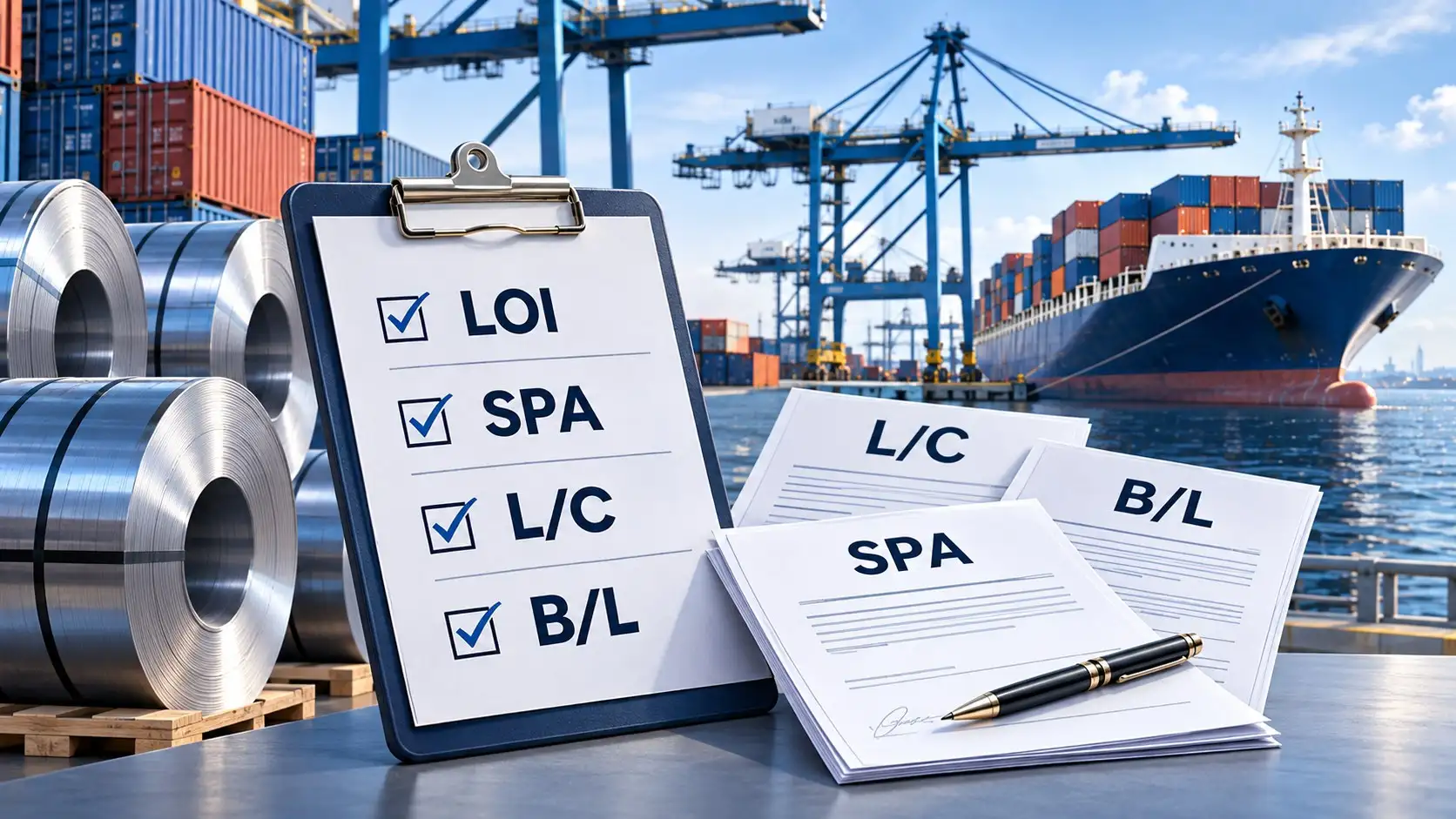
- Bill of lading (B/L). Issued by the carrier, it confirms the goods were loaded, acts as the contract of carriage and, in its negotiable form, serves as the document of title. Whoever holds the original bill can take delivery of the cargo. That is why banks hold on to it until they are paid.
- Commercial invoice. The seller’s invoice for the goods, matching the quantity and price in the contract.
- Packing list or weight list. Particularly important for steel products and polymers shipped in coils, bags or bales.
- Certificate of origin. Confirms where the goods were produced. It can affect import duties and, in some cases, whether the goods can be imported at all.
- Insurance certificate. Required under CIF terms, where the seller arranges cover for the voyage.
Checking what was actually shipped: inspection certificates
Price and paperwork mean little if the cargo is not what was ordered. That is where independent inspection comes in.
Inspection companies such as SGS, Intertek or Bureau Veritas sample and test the cargo, usually at the load port, and issue certificates of quality and quantity. For energy products the focus is often on volume and composition. For steel, it may be dimensions, coating weight and surface condition. For polymers, properties such as melt flow index and density.
The SPA should say clearly which inspection is final. If the load port result is binding, the buyer relies on the inspector at origin. If the discharge port result counts, the seller carries more risk during the voyage. Either can work, as long as both sides agree on it in writing before shipment.
Where KYC fits in
Before any of these documents are exchanged in earnest, a serious counterparty will want to know who they are dealing with. Know Your Customer checks usually ask for company registration documents, details of directors and shareholders, proof of address and sometimes bank references.
Some buyers find this frustrating, especially early in a conversation. But KYC protects both sides. It helps keep sanctioned parties and money laundering out of the deal, and it filters out the brokers who have no real mandate to buy or sell. Banks will run their own checks anyway before issuing a letter of credit, so doing it upfront usually saves time.
Warning signs to watch for
A few patterns come up again and again in deals that never close:
- An offer priced well below the market with no clear explanation.
- A request for an ICPO, proof of funds or upfront fees before the seller has shown any evidence of product.
- Long chains of intermediaries where nobody can confirm who actually holds the cargo.
- Pressure to skip inspection or accept unusual payment instruments.
- Unwillingness to complete KYC or to name the real supplier.
None of these automatically means fraud, but each one is a reason to slow down and ask more questions.
Bringing it together
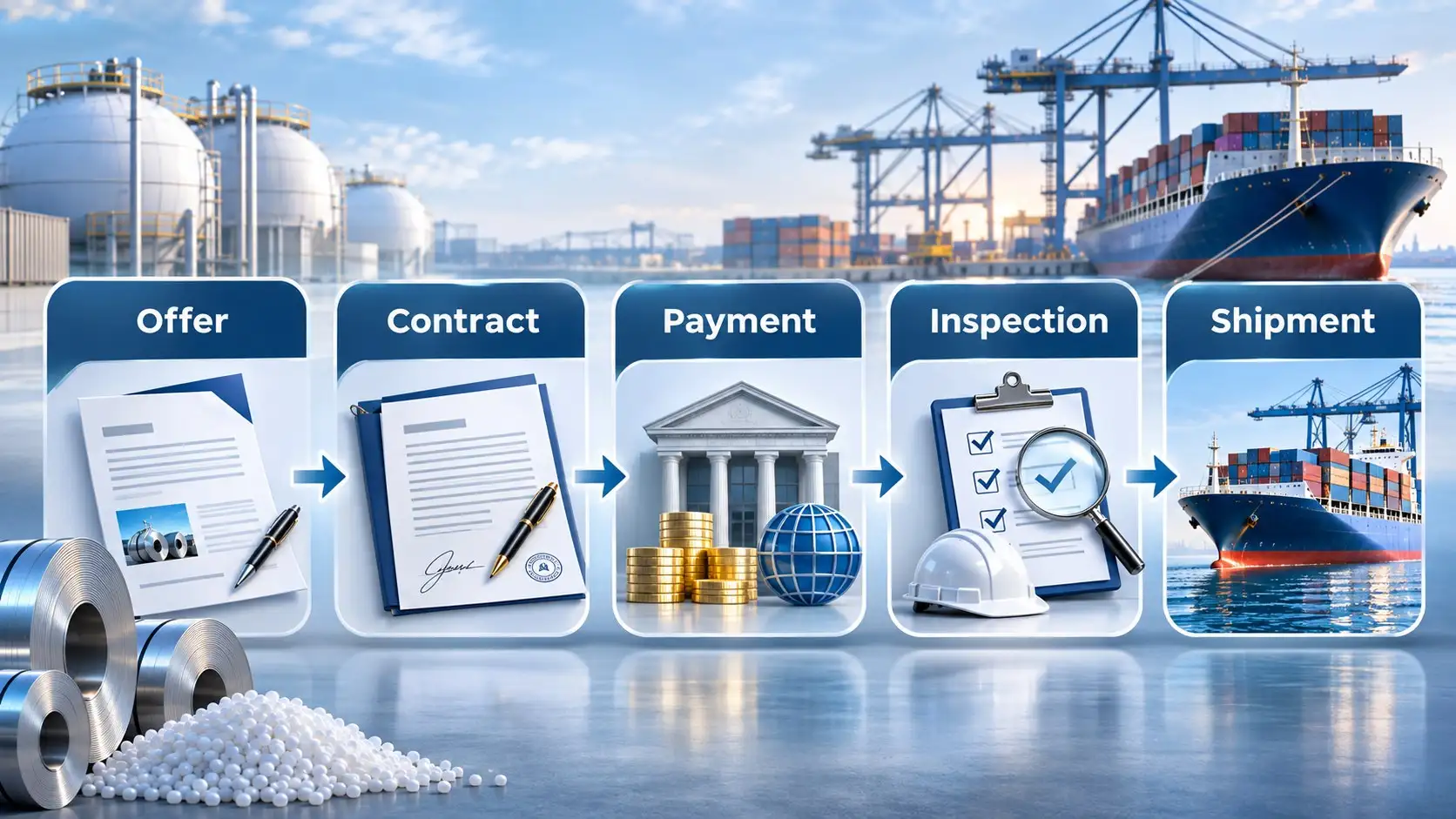
Here is how a deal typically moves. The buyer sets out a requirement, both sides verify each other through KYC, the seller makes a firm offer, the parties sign an SPA, the buyer opens the agreed payment instrument, the cargo is inspected and loaded, and the shipping documents are presented to the bank for payment. Each document hands the deal on to the next stage.
Understanding that sequence makes buyers faster and harder to mislead. It also makes it easier to see the value of working with a trading partner who takes commercial responsibility for the transaction, rather than simply passing offers along.
If you have a requirement for energy, metals or polymers and want to understand how the documentation would work for your shipment, our team is happy to talk it through.