

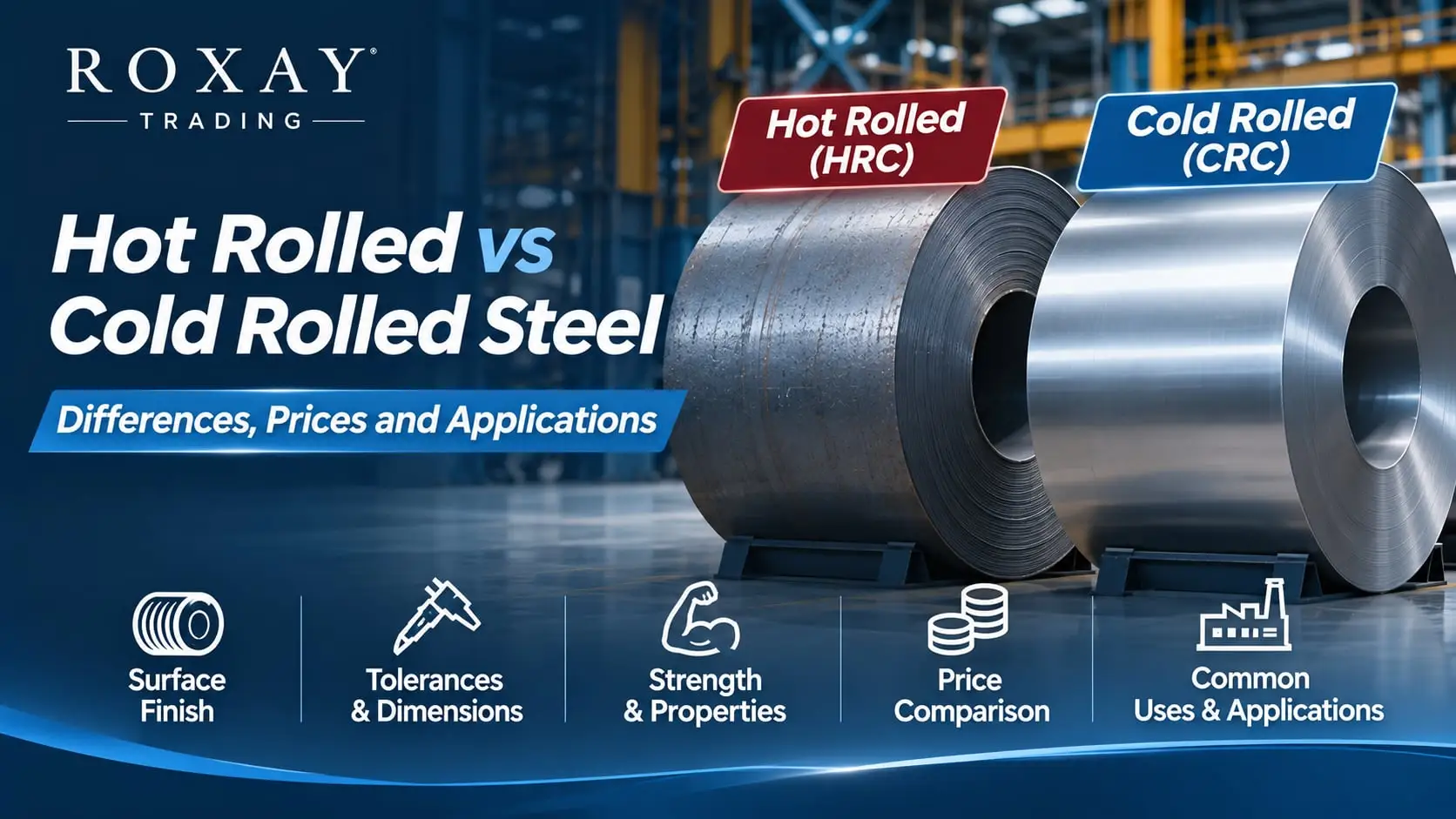
A buyer sends a request for “steel coil, 2 mm, for panels.” Two suppliers reply. One quotes hot rolled, the other quotes cold rolled, and the prices are clearly different. Both quotes say 2 mm, so which one is right?
It depends on what the steel will be used for. Hot rolled and cold rolled steel can share the same grade family and even the same thickness, but they behave differently on a production line and cost different amounts. This guide explains the differences, so the coil you order is the coil you actually need.
What is hot rolled steel (HRC)?
Hot rolled steel is rolled while it’s very hot, above its recrystallization temperature, which is often well over 900°C. At that heat the steel is soft and easy to shape. Mills can therefore reduce a thick slab to a long strip quickly and in large volumes.
When the strip comes off the mill, it’s wound into a coil. That’s where the trade name comes from: HRC, or hot rolled coil. As it cools, the surface forms a bluish-grey layer of iron oxide called mill scale. The steel also shrinks slightly as it cools, so its final dimensions are less exact than those of cold rolled steel.
HRC is one of the highest-volume steel products in the world. It’s the starting point for a long list of downstream products, and you can trace how it fits into the wider chain in our article from iron ore to steel.
What is cold rolled steel (CRC)?
Cold rolled steel begins as hot rolled steel. The hot rolled coil is first pickled in acid to remove the mill scale. It’s then rolled again at or near room temperature, which makes it thinner, smoother and more precise.
Rolling at low temperature also hardens the steel. This effect is called strain hardening. Steel straight off the cold mill (often called “full hard”) is strong but not very easy to form. For that reason, many cold rolled coils are annealed and temper-rolled afterwards, which restores their formability for pressing and deep drawing.
Put simply, CRC is HRC that has been through several more processing steps. That’s the main reason it costs more.
Hot rolled vs cold rolled steel: key differences
| Feature | Hot rolled steel (HRC) | Cold rolled steel (CRC) |
|---|---|---|
| Rolling temperature | Above recrystallization temperature | At or near room temperature |
| Surface finish | Rougher, with mill scale | Smooth and clean |
| Dimensional tolerance | Wider | Tighter |
| Typical thickness range | Roughly 1.2 mm and up | Roughly 0.15–3 mm |
| Strength | Depends on grade | Depends on grade and processing; can be higher after cold rolling |
| Cost | Generally lower | Generally higher |
| Typical applications | Construction, structural fabrication, pipes, heavy equipment | Automotive parts, appliances, furniture, precision components |
| Further processing | Pickling, cold rolling | Galvanizing, painting, coating |
Thickness ranges vary by mill. Always check the actual size range a supplier can produce before you finalize a specification.
Manufacturing process and surface finish
The production route is simple to describe. A slab is reheated, rolled hot and coiled, and the result is HRC. That coil can then be pickled, cold rolled, and often annealed and temper-rolled, and the result is CRC.
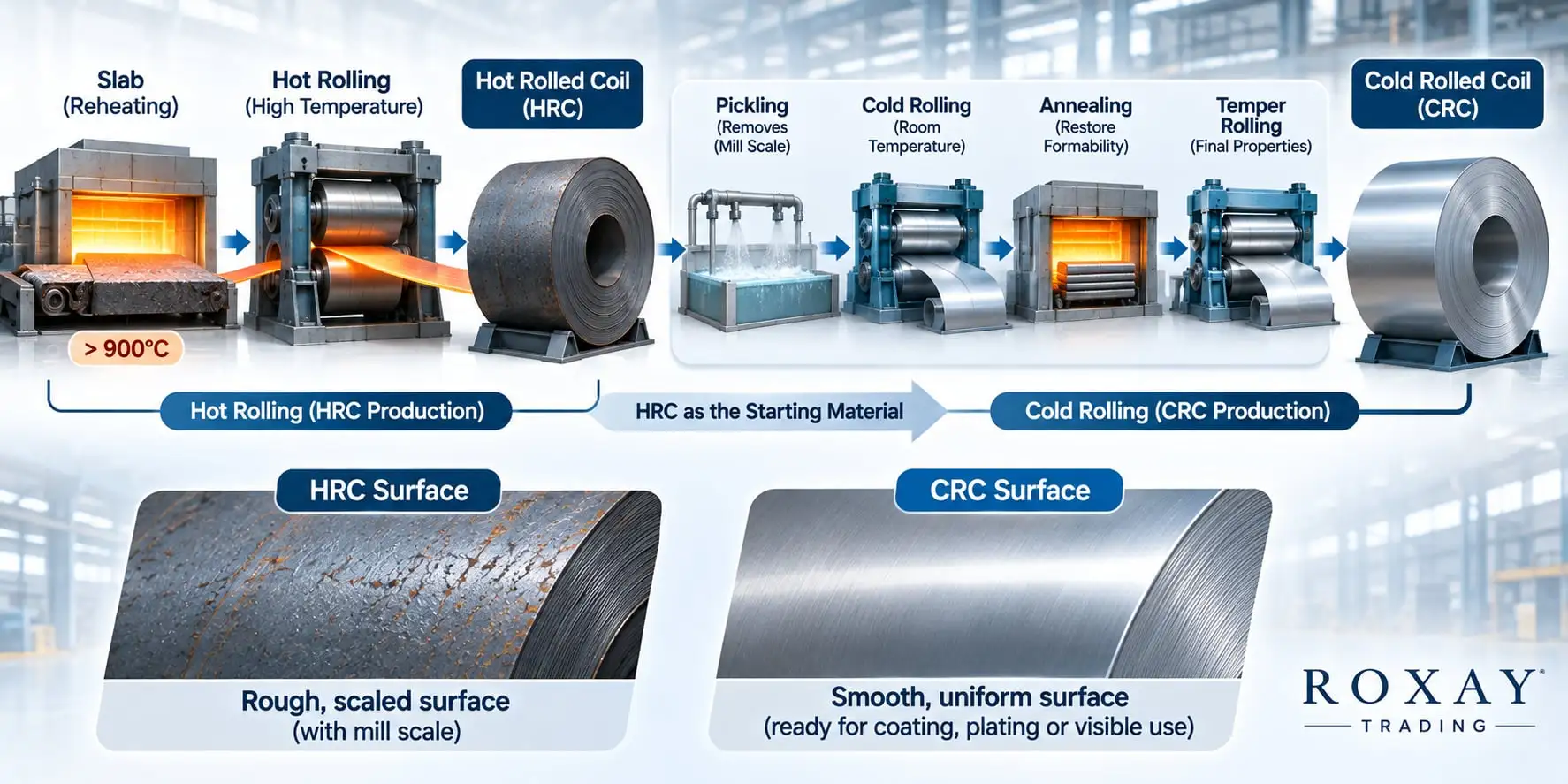
The surface finish shows where each product belongs. Hot rolled steel has a scaled surface and slightly rounded edges. That’s perfectly acceptable for structural work that will be welded, blasted or painted heavily. Cold rolled steel has a clean, uniform surface that’s ready for coating, plating or visible use. Depending on the order, it can be supplied matte or bright.
If paint adhesion or appearance matters, the surface finish should be written into the specification from the start.
Strength, hardness and dimensional tolerances
Strength. A common assumption is that cold rolled steel is always stronger. That’s only partly true. Cold rolling can raise yield and tensile strength, but annealing then reduces some of that gain in exchange for better formability. In practice, the grade and the processing route matter more than whether the steel is labeled “hot” or “cold.”
Hardness. Full hard cold rolled steel is noticeably harder than hot rolled steel. Annealed CRC is softer and much better suited to bending and pressing.
Tolerances. This is where cold rolled steel has a clear advantage. Thickness, flatness and width are held to tighter limits, which matters for automated stamping, appliance panels and any part that has to fit precisely. A few tenths of a millimeter can make a real difference to scrap rates on a production line.
Hot rolled vs cold rolled steel: price comparison
Cold rolled steel usually costs more than hot rolled steel of a comparable grade, and the reasons are straightforward:
- Extra processing: pickling, cold rolling, annealing and temper rolling all add energy and labor costs.
- Yield loss: each extra step produces some scrap.
- Tighter quality control: closer tolerances and surface standards cost more to hold.
The size of the price gap changes with market conditions. It depends on raw material costs, mill capacity, demand from automotive and appliance makers, freight rates and trade measures in the destination country. HRC prices are also widely watched as an indicator for the wider steel market. You can read more about these factors in our article on commodity prices.
When you compare quotes, check that both cover the same grade, thickness, tolerance, surface finish and Incoterm. A lower price sometimes simply reflects a different specification.
Industrial applications of HRC and CRC
Hot rolled steel suits jobs where strength and cost matter more than surface finish:
- Welded beams, frames and building components fabricated from hot rolled sheet or strip
- Welded pipes and tubes
- Rail cars, trailers and heavy machinery
- Agricultural equipment
- Feedstock for further processing
Cold rolled steel suits jobs where finish, precision or formability matters:
- Automotive body and interior parts
- Household appliances such as washing machines and fridges
- Steel furniture, shelving and lighting fixtures
- Electrical enclosures and panels
- Substrate for coated products
What is pickled and oiled steel (HRPO)?
Pickled and oiled steel sits between hot rolled and cold rolled steel. It’s hot rolled steel that has been pickled to remove mill scale, then coated with a light film of oil to protect the bare surface from rust during storage and shipping.
It has a cleaner surface than standard hot rolled steel and costs less than cold rolled steel. That makes it a popular choice for parts that need good weldability and paint adhesion without cold rolled precision, such as automotive brackets, wheels and pressed components. If you’re looking at this middle option, see our page on pickled hot rolled steel.
How HRC and CRC are used in galvanized and pre-painted steel
Many coated steel products start life as one of these two coils.
Galvanized steel (GI) is usually made from cold rolled full hard substrate, because its smooth, even surface takes a consistent zinc coating. Thicker galvanized products can be made from pickled hot rolled substrate.
Pre-painted steel (PPGI) goes one step further: the galvanized coil is cleaned, primed and coated with paint on a continuous line. Uniform thickness and a clean surface are important here, which is why the quality of the base coil affects the finished product.
So even if you buy only galvanized steel coil or pre-painted steel, it’s worth understanding the substrate underneath.
How to choose the right steel coil for your business
These questions usually point to the right product:
- Will the surface be visible, painted or coated?
- Does the part need to be bent, pressed or deep drawn?
- How tight do the thickness and flatness tolerances need to be?
- What thickness do you need? Above about 3 mm, cold rolled options become limited.
- Is cost per tonne the main factor, or is scrap rate on your line more important?
- Which standard does your customer or project require?
As a rule of thumb, choose hot rolled steel for structural strength at lower cost and cold rolled steel for precision and finish. Pickled and oiled steel is worth considering when you need something in between.
What to check before importing steel coils
Importing steel coils involves more than agreeing a price per tonne. Before you confirm an order, make sure these points are clear:
- Grade and standard: for example EN 10111 or ASTM A1011 for hot rolled sheet, EN 10130 (DC01–DC06) or ASTM A1008 for cold rolled, and JIS G 3131 (SPHC) or JIS G 3141 (SPCC) for Asian mills.
- Dimensions and tolerances: thickness, width, coil weight and inner diameter, plus the tolerance standard that applies.
- Surface condition: mill finish, pickled and oiled, matte or bright, oiled or dry.
- Mill test certificate: ideally an EN 10204 3.1 certificate showing chemical composition and mechanical properties.
- Inspection: whether third-party inspection will take place before loading.
- Packaging: seaworthy packing to protect coils from moisture and handling damage.
- Incoterms and payment: who covers freight, insurance and risk under FOB, CIF and CFR, and how payment will be secured.
- Customs classification and duties: flat-rolled non-alloy steel is usually classified under HS 7208 (hot rolled) or 7209 (cold rolled), and some markets apply anti-dumping or safeguard duties.
A clear, complete specification is the best protection against disputes later. For a wider view of the buying process, see our guide to global commodity sourcing.
Sourcing steel coils with ROXAY Trading
Choosing between hot rolled and cold rolled steel usually depends on how the part will be used, so clear requirements matter more than the label on the quote.
ROXAY Trading works with buyers in China, India, Pakistan and across Africa on international steel trade. Our steel products include pickled hot rolled, galvanized and pre-painted steel. If you’re comparing options, submit your steel requirement with the grade, dimensions, quantity and destination port. We’ll review it with you.
Final suitability always depends on the full technical specification and the mill certificates for the specific material, so share as much detail as you can from the start.